


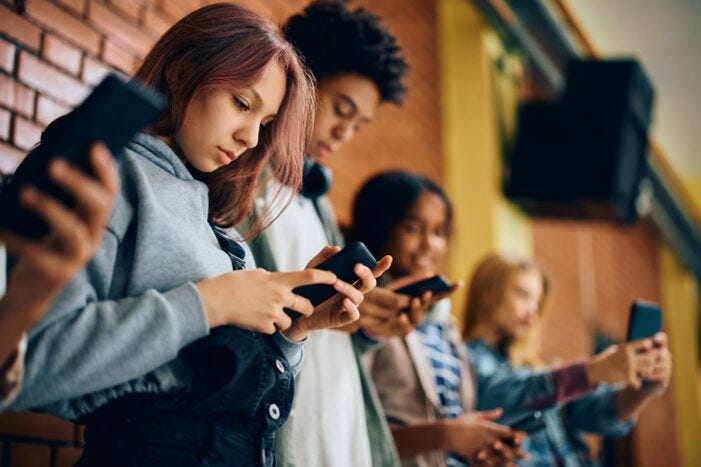
One of the best parts about being a researcher is getting to work with really creative and smart young scholars. This week, we published a new paper led by Anthony Chen, a former postdoctoral researcher on my team, showing that passive scrolling may be a symptom not a cause of adolescents’ emotional states.
We took a different approach than just asking adolescents what they are up to online. Instead, we installed keyboards on their devices and, with their consent, captured every keystroke they entered over the course of 90 days.
We took a different approach because just asking young people, or anyone for that matter, to report on their screen time is not a very reliable way to capture device use. In fact, researchers have found that self-reported media use is only moderately correlated with objectively logged use.
Did we really install keyboards on adolescents’ phones?
Yes, and it worked!
In this new study we used keyboard entries from a platform called EARS (Effortless Assessment Research System), alongside measures of how long adolescents spent on different types of apps throughout the day (and night!).
In addition to computing total time on different types of apps, we separated out adolescents’ active use (as measured by their keyboard touches and typing), from passive use (watching videos and scrolling), to test how each type of usage was related to their future affect (sadness, worry, anxiety as well as their reports of optimism and feeling good). We also tested whether their phone usage predicted their sleep that night.
Because we had so much data, close to 3,200 days of typing, app logging, and reported affect captured across multiple months of assessment, we could use each adolescent as their own control. This means that instead of comparing a young person who typically spends one hour a day online with one who spends 5 or more hours (which is often done and results in comparisons between very different types of kids who live in very different types of environments), we could compare each adolescent to themselves across days. So, we could ask questions like:
On days when an adolescent spends more time than they usually do passively scrolling, do they go on to experience worse negative affect or suffer from worse sleep?
So what did we find?
Anthony has already posted about our main findings here, which are generating a lot of reactions and discussion. Maybe people are responding because the findings were not what they expected. The results run counter to what we have been repeatedly told about the influence of screen time and online engagement on adolescents’ sadness, anxiety, worry and their sleep (which we captured here using both built-in sensors from the phone and morning reports of sleep quality).
Here are the takeaways:
Adolescents’ daily phone use did not predict their next-day affect, but
On mornings when a teen woke up feeling worse than usual, they spent more time passively browsing on their phone that day (again, this is compared to their own use and affect on other days).
And, here is another surprising finding:
Daily phone use did not predict shorter sleep duration or how tired an adolescent felt the next day.
These findings are surprising, I know. Because we are constantly told that the relationship goes the other way around and that time online is the cause of young people losing sleep and feeling bad.
Is this the final word on the influence of phones on adolescents’ affect and sleep?
Of course not. This is a single study, which, like all studies, has limitations. And like the vast majority of other studies that test for the influence of screen time on adolescent wellbeing, the associations were small. Because we had so many observations, we were powered to find very tiny effects.
Similar to what we see in other studies, if we are searching for strong predictors of young people’s affect and mental health, we should be looking somewhere other than their phones.
Although we had a massive amount of data, this study involved only 40 adolescents, so it should be replicated with a larger group. Interestingly, another study using passively sensed app usage among 10,000 adults found few robust associations between objective measures and daily wellbeing over four weeks (250,000 days of data!). Here the associations with social media were so small that the authors estimated that 18 more hours of daily app use (an impossible amount considering that they also had to sleep) would be required to produce a one-point shift on the mood rating scales!
Although not the final word, these results should be a reminder that there is a large distance between what we are constantly told is happening in the daily lives of adolescents on their screens versus what is captured when we log data directly from adolescents’ devices.
Maybe we have been drawing the causal arrow between screens and adolescent wellbeing the wrong way around. What are we missing when we fail to see excessive phone use among teens as a symptom of something larger happening in their lives?
This is very interesting research. Check out Dr. Peter Gray’s new book “Restoring Childhood”. I think it’s related to this research.
Since each teen is different in temperament, different needs, interests, propensities for anxiety, etc were any genetic or personality studies done?